


Latest News
When the Pressure Follows You Home: Mental Health, Money Worries and the Construction Workforce
Posted on Wednesday, 1st July 2026
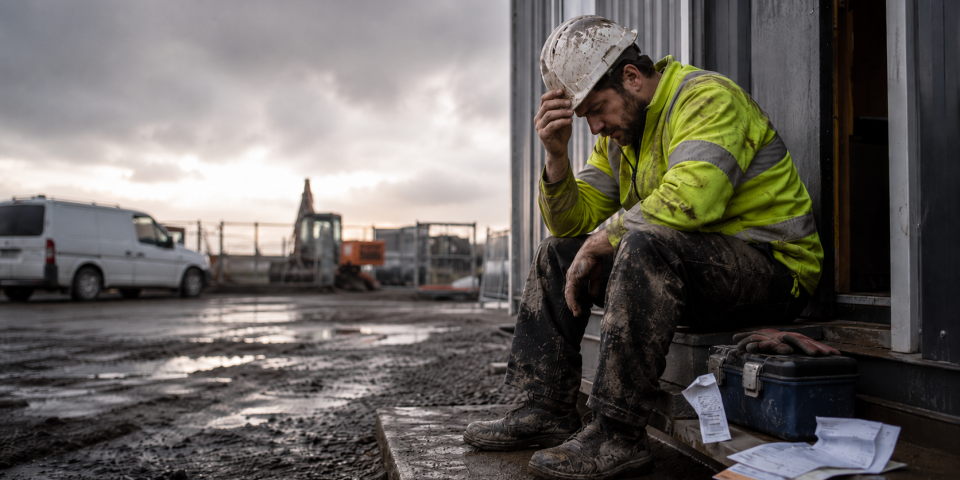
There is a silent risk on site that does not wear a hi-vis vest.
It is not falling from height. It is not dust. It is not machinery.
It is the worker who turns up every morning with £38 left until payday.
The supervisor who has not slept properly in weeks.
The subcontractor pretending everything is fine while fuel, food, rent, tax, bills and debt are eating through their wages like rust through steel.
This is not “having a bad day”. This is pressure building behind the hard hat.
And right now, that pressure is everywhere.
The cost-of-living crisis has not gone away
Inflation may not be at the frightening peak we saw in 2022, but that does not mean life has become affordable again. The House of Commons Library states that the cumulative effect of rising prices means households are still facing a much higher cost of living than in 2021, with more recent pressure from higher fuel prices linked to the Middle East conflict.
ONS data shows CPI rose by 2.8% in the 12 months to May 2026, while CPIH rose by 3.0%. But inflation slowing does not mean prices are falling. It means the squeeze is tightening more slowly.
For many workers, the maths is brutal:
- Your van costs more to run.
- Your food shop costs more.
- Your rent or mortgage is heavier.
- Your energy bill still bites.
- Your wages may not stretch.
- Your tax and National Insurance deductions still come out before you see a penny.
HMRC’s 2025 to 2026 employer figures show businesses paying employer National Insurance at 15% above the secondary threshold, with the threshold set at £5,000 per year. For employers, that means another cost pressure. For workers, it can mean tighter margins, fewer pay rises, less overtime, leaner teams and more stress passed down the chain.
This is not just an economic issue. It is a mental health issue.
The numbers should stop us in our tracks
In Great Britain, HSE figures for 2024/25 show 1.9 million working people suffering from work-related illness. Of those, 964,000 were suffering from work-related stress, depression or anxiety.
Stress, depression and anxiety also accounted for 22.1 million lost working days in 2024/25. On average, each person affected lost 22.9 working days.
That is not “soft”. That is absence, disruption, mistakes, fatigue, conflict, turnover and real human pain.
And in construction, the picture is darker still.
The Chartered Institute of Building’s 2025 report into mental health in the built environment surveyed 2,081 construction workers. More than a quarter, 26%, said they had experienced suicidal thoughts. Only 56% said their business had a mental health policy.
Read that again.
More than one in four.
That means on a busy site, in a training room, in a depot, in a gang, there may be someone standing next to you who has already wondered whether the world would be better without them.
Money worries do not clock off
Financial pressure is not just about spreadsheets. It crawls into sleep, patience, relationships and concentration.
ONS data collected between October 2025 and January 2026 found that 62% of adults said their cost of living had increased compared with a month earlier. Among those reporting higher costs, 94% pointed to food shopping, 68% to gas or electricity bills and 46% to fuel.
That is the world your team is walking into before they even start work.
Someone may be operating plant while worrying about a missed payment.
Someone may be climbing scaffold after an argument about money at home.
Someone may be making safety-critical decisions after four hours’ sleep.
Someone may be smiling in the canteen while feeling completely trapped.
The old answer was “get on with it”.
That answer is costing lives.
Depression does not always look like crying
On site, depression can wear a convincing mask.
It can look like anger.
It can look like silence.
It can look like turning up late.
It can look like taking risks.
It can look like drinking more.
It can look like snapping at apprentices.
It can look like “banter” that suddenly has a sharper edge.
It can look like a good worker becoming unreliable.
It can look like someone who always says, “I’m fine.”
Mental health training matters because it teaches people to spot the shift before it becomes a crisis.
Not to diagnose.
Not to pry.
Not to play therapist.
To notice. To ask. To listen. To signpost. To act.
Ask yourself honestly: how are you really?
Pause here. No bravado. No workplace mask. No “mustn’t grumble”.
Over the last two weeks:
Have you felt constantly tired, wired or unable to switch off?
Have you lost interest in things you usually enjoy?
Are you avoiding people, calls, messages or home conversations?
Are you using alcohol, gambling, drugs, spending or isolation to cope?
Are money worries making it hard to sleep?
Are you more angry, numb, tearful or hopeless than usual?
Are you making mistakes because your head is somewhere else?
Have you thought, “I can’t keep doing this”?
If you answered yes to several of these, you do not need to wait until you “break” to get support.
Support is not weakness. It is maintenance. We service machinery before it fails. We inspect harnesses before someone falls. We should treat mental health with the same seriousness.
Support is available now
The Lighthouse Charity provides free 24/7 emotional, physical and financial wellbeing support for construction workers and their families, including a helpline, live web chat, text support, self-support app, Lighthouse Beacons and its Wellbeing Academy.
If you are struggling, use them.
UK helpline: 0345 605 1956
Text HARDHAT to 85258
Lighthouse Charity support:
Their Wellbeing Academy also offers courses designed for the construction community, including Mental Health First Aid training that helps people recognise and address mental health issues professionally.
Essential Site Skills also offers mental health and wellbeing training designed to give individuals, teams and organisations the confidence to recognise signs of poor mental health, start supportive conversations and build a more proactive wellbeing culture.
Our Mental Health First Aid course options include:
Adult Mental Health Awareness, half day
Mental Health First Aid, two days
Mental Health First Aid Champion, one day
Mental Health First Aid in a Construction Environment, one day
This is why training matters
A mental health course will not pay someone’s gas bill.
But it can help a manager notice when someone is spiralling.
It can give a supervisor the words to start a difficult conversation.
It can help a colleague understand when “leave me alone” might actually mean “please don’t give up on me”.
It can stop silence becoming danger.
It can help a business build a culture where asking for support is normal, not shameful.
And let’s be blunt: if your business trains people to use ladders, abrasive wheels, first aid kits and fire extinguishers, but does not train them to respond to mental health risk, there is a gap in your safety culture.
A serious one.
Book the course before the crisis
Mental health training is not just for HR. It is for site managers, supervisors, directors, operatives, apprentices, office teams and anyone who works with people under pressure.
Because pressure is no longer occasional. It is the weather system we are working in.
Rising prices. Fuel uncertainty. Tax pressures. Debt. Job insecurity. Family strain. Long hours. Physical pain. Deadlines. Silent shame.
The question is not whether mental health is affecting your workforce.
The question is whether you are prepared to see it, talk about it and respond properly.
Book an Essential Site Skills mental health and wellbeing course today:
Do it for your team.
Do it for your business.
Do it for the person who has not told you they are struggling yet.
Do it for yourself.
Because the strongest sites are not the ones where nobody struggles.
They are the ones where nobody has to struggle alone.