


Latest News
Construction Environmental Management Plans in 2026: What Site Supervisors Need to Check
Posted on Monday, 24th August 2026
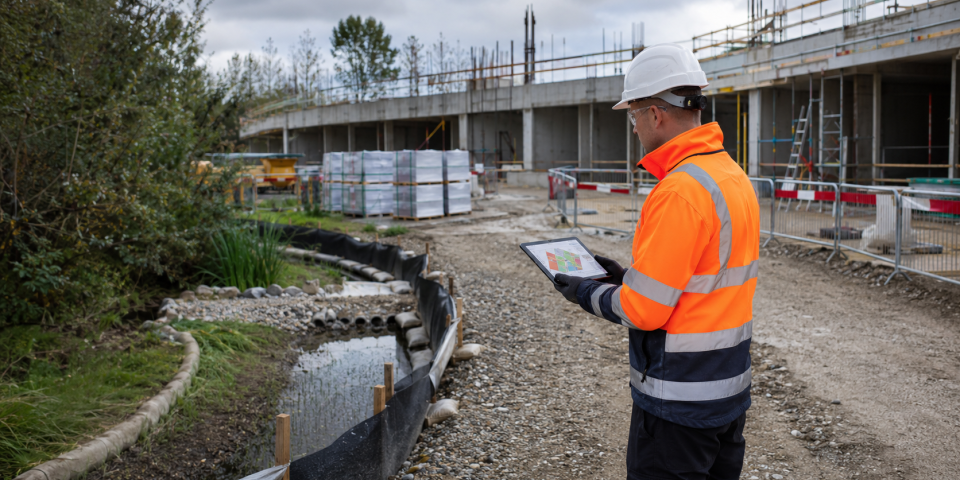
Environmental requirements can change between tender, planning approval and construction. The programme moves, subcontractors change and unexpected ground conditions appear. Meanwhile, the controls agreed with the client, planning authority, ecologist or regulator still have to work on site.
That is the purpose of a construction environmental management plan, commonly shortened to CEMP. It translates environmental risks, legal requirements and project commitments into arrangements that can be implemented during construction.
The need for that translation is particularly clear in 2026. Changes to England’s Biodiversity Net Gain framework took effect on 6 August, with further requirements for nationally significant infrastructure projects due from 2 November. Workplace recycling rules already expressly cover construction sites, while pollution, waste, nuisance and permit duties continue to apply.
The person supervising the work may not have written the CEMP. However, they are often the person expected to make its controls happen.
What this means on site
A CEMP should tell the site team what must be protected, what controls are required, who owns each action, when checks must happen and what evidence must be retained.
If it is too generic to answer those questions, it is not yet an effective site-management document.
What is a construction environmental management plan?
A construction environmental management plan sets out how a project will identify, control, monitor and respond to environmental impacts during the construction phase.
It should connect four things:
- Requirements: legislation, planning conditions, permits, consents, client standards and project commitments.
- Risks: the activities, locations and changes that could cause environmental harm or non-compliance.
- Controls: the physical measures, procedures, responsibilities and hold points used to manage those risks.
- Evidence: inspections, monitoring, records, approvals and corrective actions demonstrating that controls were implemented.
Depending on the project or organisation, the document may have a different name. It may sit beneath a wider environmental management system or be supported by separate plans for waste, drainage, ecology, noise, dust or emergency response.
The title matters less than whether all relevant requirements are carried through into the work.
Is a CEMP legally required on every construction project?
There is no single rule stating that every UK construction project must use a document called a CEMP.
However, a CEMP may be required by:
- a planning condition;
- an environmental permit, consent or licence;
- the client, principal contractor or contract specification;
- an organisation’s certified environmental management system;
- a development consent order or other project approval; or
- commitments made within an environmental assessment, biodiversity plan or method statement.
Even where no formal CEMP is required, the underlying legal duties still apply. A project must still manage its waste, prevent pollution, comply with permits, control statutory nuisance and protect relevant habitats, species and heritage assets.
The first step is therefore not downloading a standard template. It is identifying which obligations and commitments apply to the particular site.
Why generic CEMPs fail on site
Many weak plans contain sensible statements: prevent pollution, minimise waste, protect biodiversity and reduce disturbance. The problem is that those statements do not tell a supervisor what to check on Tuesday morning before work starts.
A usable control should answer:
Question | Practical example |
What is the risk or commitment? | Silt-laden water must not enter the surface-water drainage system |
Where does it apply? | Northern excavation and drain runs shown on the current drainage plan |
What is the control? | Cut-off ditch, settlement unit and protected drain inlets |
Who owns it? | Groundworks supervisor, with environmental manager oversight |
When must it be checked? | Before pumping, after heavy rainfall and during the weekly inspection |
What triggers escalation? | Discoloured discharge, failed treatment, overtopping risk or changed pumping location |
What evidence is retained? | Inspection record, photographs, discharge approval and corrective-action record |
“Use appropriate controls” is an intention. The information above is an arrangement that can be supervised.
What should a CEMP include in 2026?
The exact content should reflect the project’s location, activities, conditions and approvals. The following structure provides a practical starting point.
1. Scope, status and document control
The plan should define which works, locations and phases it covers. It should show the current revision, author, approver, review date and how updates will reach the workforce.
If several environmental documents apply, include a clear hierarchy and register. A supervisor should not have to guess whether a planning-condition document, subcontractor method statement or later ecological instruction takes priority.
2. Roles, authority and communication
Name the people responsible for implementing, inspecting and escalating each part of the plan. Include deputies and out-of-hours arrangements where an incident could occur outside normal working hours.
Responsibilities might sit with the project manager, site manager, environmental manager, supervisors, logistics team, ecological clerk of works and specialist subcontractors. The plan should also explain who can:
- authorise an environmentally sensitive activity to start;
- stop work when a control is absent or ineffective;
- communicate with a regulator, planning authority or client;
- approve a change to the method or control; and
- report an environmental incident externally.
3. Legal and other requirements
Maintain a project-specific register of relevant legislation, planning conditions, permits, licences, consents and client commitments. Assign an owner and evidence requirement to each item.
A long list of environmental legislation copied from another project is not enough. The plan should explain what each relevant requirement means for the work, whether an approval must be obtained before a particular activity and when any permission expires.
4. Site constraints and sensitive receptors
Map the features that could be affected by construction, including:
- surface-water and foul drains;
- rivers, ditches, ponds and groundwater protection areas;
- neighbouring homes, schools, businesses and public routes;
- retained trees, hedgerows, habitats and protected areas;
- protected species and agreed exclusion zones;
- contaminated ground and invasive plants;
- archaeological or heritage features; and
- areas at risk from dust, noise, vibration, light or mud.
Make the map usable in the site office and at work fronts. The latest site layout, drainage plan and ecological constraints should agree with one another.
5. Water, drainage and pollution prevention
Environment Agency guidance on pollution prevention makes clear that businesses should assess and minimise pollution risks and know how they will respond to an incident.
For a construction project, the CEMP may need to address:
- clean- and dirty-water separation;
- excavation water and dewatering;
- silt control and settlement capacity;
- concrete and cement washout;
- refuelling and plant maintenance;
- drain protection and drainage identification;
- stockpiles and contaminated run-off;
- weather monitoring and heavy-rainfall response; and
- permissions for discharges or work near water.
Avoid relying on withdrawn Pollution Prevention Guidance as if it were current regulatory guidance. Use current Environment Agency and GOV.UK information, project permits and specialist advice.
Current Environment Agency and GOV.UK guidance, project permits and any relevant regulatory position statements should be checked before work begins. Where an RPS applies, check that all of its conditions are met before relying on it.
6. Fuels, oils, chemicals and spill response
Identify approved delivery, storage, transfer and refuelling areas. Specify containment, security, inspection and maintenance requirements, as well as the location and type of spill equipment.
The incident plan should set out immediate actions, internal contacts, regulator reporting arrangements and the process for recovering contaminated materials. Workers should know that washing a spill into a drain is not a clean-up method.
Test the arrangements. A spill drill can reveal missing drain covers, unsuitable equipment or uncertainty about who has authority to call the Environment Agency’s incident hotline.
7. Waste and material management
The CEMP should connect waste prevention and material efficiency with compliant storage, classification and transfer. Include arrangements for:
- preventing damage and over-ordering;
- re-use and take-back schemes;
- defined, labelled waste streams;
- hazardous and non-hazardous waste;
- carrier and destination checks;
- waste transfer and consignment records;
- secure storage and prevention of escape; and
- investigating contamination or rejected loads.
In England, Simpler Recycling expressly applies to construction sites. Household-like dry recyclables, food waste and residual waste must be separated as required and the recyclable streams covered by the guidance must not be mixed or compacted with other construction waste. Micro-firms have until 31 March 2027 to comply.
The CEMP should state how those workplace streams integrate with the project’s construction and demolition waste arrangements.
8. Dust, noise, vibration, light and good-neighbour controls
Identify likely sources, affected receptors, agreed working hours, monitoring thresholds and complaint-response arrangements. Controls may include task selection, dampening, enclosures, acoustic barriers, equipment positioning, logistics planning and liaison with neighbours.
Avoid promising that the project will create “no noise” or “no dust”. State the specific controls, monitoring and corrective actions the project can deliver.
Where a local authority has approved working methods or restrictions, ensure subcontractors receive the actual requirements before pricing and planning the work.
9. Soil, contaminated land and unexpected materials
Set out how soils will be stripped, stored, protected, tested, moved and reinstated. Keep different soil types and contaminated materials separate where required.
Include a stop-work and escalation process for unexpected odours, staining, tanks, made ground, asbestos-containing materials or other suspected contamination. The person discovering it should not be expected to decide alone whether it is safe or lawful to continue.
10. Ecology, biodiversity and invasive species
The CEMP should implement the approved ecological controls, not replace professional ecological advice. It may include:
- retained-habitat protection;
- ecological exclusion zones and fencing;
- seasonal or timing restrictions;
- pre-work inspections and watching briefs;
- lighting controls;
- nesting-bird and protected-species procedures;
- invasive-species biosecurity; and
- responsibilities for habitat creation or reinstatement.
Biodiversity Net Gain changes from 6 August 2026
England’s Biodiversity Net Gain requirements changed from 6 August 2026, with a separate framework due to apply to nationally significant infrastructure projects from 2 November 2026. These are not requirements for a supervisor to interpret without support. Site teams should be given the approved biodiversity information, habitat boundaries, sequencing requirements and hold points relevant to the work, and the CEMP should be updated if the approved approach changes.
11. Archaeology and heritage
Record known constraints, protection measures, watching briefs and the unexpected-discovery procedure. A clear stop-work process is essential because an archaeological find cannot be managed retrospectively after it has been disturbed.
12. Inspection, monitoring and corrective action
Define what will be inspected, by whom and how often. Frequencies should respond to risk and conditions rather than relying only on a fixed weekly form.
Some controls need additional checks:
- before an activity starts;
- following heavy rain or high winds;
- after a site-layout or drainage change;
- after a complaint, near miss or incident;
- when a new subcontractor begins; or
- before entering a sensitive area.
Record defects with an owner and deadline. Closure should mean the corrective action has been checked, not merely that somebody has added a comment to the inspection form.
The supervisor’s CEMP implementation checklist
Before an activity starts
- Confirm that the current CEMP and relevant drawings are available.
- Identify the environmental constraints and approvals affecting the work area.
- Check whether a permit, consent, ecological inspection or hold-point release is required.
- Review the subcontractor’s proposed method against the CEMP.
- Verify that physical controls, monitoring equipment and emergency materials are present.
- Brief the workforce on the controls, boundaries, stop-work triggers and reporting route.
- Record authorisation where the plan requires it.
During the work
- Check that the activity remains within the approved location and method.
- Inspect controls at the frequency and trigger points stated in the plan.
- Look beyond paperwork for changes in weather, drainage, ground, neighbouring activity or site layout.
- Challenge contamination, uncontrolled discharge, damaged fencing, excessive nuisance or unauthorised material movement.
- Record readings, inspections, photographs and corrective actions accurately.
- Stop and escalate when conditions fall outside the approved plan.
At the end of the activity or shift
- Leave storage, containment, drainage and sensitive areas secure.
- Confirm waste and surplus materials have followed the agreed route.
- Close or hand over outstanding environmental actions.
- Report any incident, complaint, unexpected condition or departure from the plan.
- Capture lessons that should change the method, briefing or CEMP.
Change control: the part of the CEMP most likely to be missed
Construction changes constantly. A control designed for the original sequence may become ineffective when access moves, a drainage run is connected, excavation volumes increase or a different product is introduced.
Before accepting a change, ask:
- Does it alter an environmental risk, receptor or commitment?
- Is a revised design, permit, consent or specialist approval needed?
- Does it affect drainage, waste classification, ecology, noise or working hours?
- Must a hold point be repeated?
- Which documents, drawings and briefings need updating?
- How will the site verify that the revised control works?
An informal agreement in a meeting is not enough when the workforce continues using an outdated drawing or method statement.
What evidence demonstrates that the CEMP is working?
Good evidence is proportionate, traceable and linked to the requirement it supports. It may include:
- permit, consent and planning-condition records;
- induction, briefing and competence records;
- inspection forms and time-stamped photographs;
- water, dust, noise or vibration monitoring;
- waste records and carrier checks;
- ecological inspections and hold-point releases;
- maintenance and calibration records;
- complaints, incidents and regulator correspondence;
- corrective-action and close-out records; and
- approved changes and revised plans.
Volume is not the goal. Hundreds of photographs with no location, date or control reference are difficult to use. Decide what evidence is needed before the work starts and store it consistently.
How SEATS supports CEMP implementation
A CEMP can be prepared by environmental specialists, but many of its controls depend on everyday supervisory decisions: where materials are stored, whether a drain is protected, when work stops, how workers are briefed and whether a defect is escalated.
The CITB Site Environmental Awareness Training Scheme (SEATS) supports people with supervisory responsibilities in understanding environmental legislation and management systems, pollution prevention, resource and waste management, soil contamination, ecology, statutory nuisance and heritage.
Those subjects align with the controls supervisors are commonly asked to implement through a CEMP. The value is not simply recognising an environmental term; it is understanding why a control exists and when poor practice needs to be challenged.
SEATS does not qualify someone to write every specialist part of a CEMP, calculate Biodiversity Net Gain, assess contamination or issue an environmental permit. It provides construction-specific environmental awareness that supports competent supervision within an organisation’s wider arrangements.
View upcoming CITB SEATS course dates on the Essential Site Skills training calendar.