


Latest News
Construction Site Security: What the Law Says About Protecting the Public
Posted on Monday, 17th August 2026
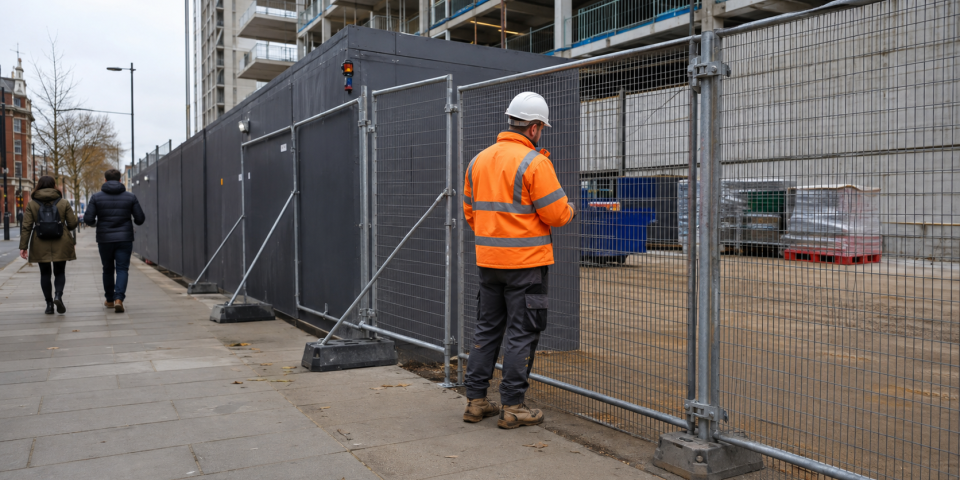
A locked gate does not automatically make a construction site secure.
Not if a fence panel is loose. Not if a ladder still provides access to the scaffold. Not if an excavation beside the boundary is left uncovered or a stack of pipes could roll.
The site may be closed. It is not necessarily safe.
In June 2026, the Health and Safety Executive (HSE) urged construction companies to strengthen site security as the school holidays approached. Its warning focused particularly on stopping children from entering sites and being injured by hazards that may appear exciting rather than dangerous.
The reminder was seasonal. The legal duty is not.
Construction sites must be managed to protect workers, visitors and members of the public throughout the project, during working hours and after everybody has gone home.
This guide explains the UK construction site security requirements, who is responsible and what a sensible site-security check should cover.
The Quick Answer: Do Construction Sites Have to Be Secured?
Yes. Every construction site requires measures to manage access across defined boundaries and prevent unauthorised people from entering.
The precautions must reflect the level of risk. A small, remote project will not necessarily need the same arrangements as a city-centre development beside a school, housing estate or busy pavement. However, the people controlling the work must be able to show that the boundary, access points and risks to the public have been properly considered and controlled.
In plain English: site security must be suitable for the actual site, not simply copied from the last construction phase plan.
What Does the Law Say About Construction Site Security?
Construction site security is a health and safety duty, not merely a way to prevent theft.
Health and Safety at Work etc. Act 1974
Section 3 of the Health and Safety at Work etc. Act 1974 requires employers and self-employed people to conduct their undertaking, so far as is reasonably practicable, without exposing people who are not their employees to health and safety risks.
That includes neighbours, pedestrians, visitors, delivery drivers and anybody else who may be affected by construction work.
Construction (Design and Management) Regulations 2015
The Construction (Design and Management) Regulations 2015 - usually shortened to CDM 2015 - place more specific duties on construction clients, principal contractors and contractors.
Regulation 18 covers good order and site security. Where necessary in the interests of health and safety, and in line with the risk posed, the site's perimeter must be readily identifiable through suitable signs and site arrangements, be fenced off, or use both measures.
CDM also makes the responsibility for unauthorised access clear:
Dutyholder | What Site Security Means in Practice |
Client | Provide relevant pre-construction information about boundaries, neighbouring land, access and measures to exclude unauthorised people. Make suitable project arrangements and check that dutyholders are carrying out their roles. |
Principal contractor | Plan, manage, monitor and co-ordinate the construction phase, including taking the necessary steps to prevent unauthorised access. |
Contractor | Do not begin work unless reasonable steps have been taken to prevent unauthorised people from accessing the site. Manage the matters within the contractor's control. |
Workers | Follow access and security arrangements, secure gates and hazards as instructed, and report damage, gaps or unsafe changes promptly. |
Security is therefore not a job that can be handed to the person locking the gate at 5 pm. It begins with the client information and project planning, continues through the construction phase and depends on daily site behaviour.
Does Every Construction Site Need a Two-Metre Fence?
There is no single fence height prescribed for every construction site in every situation. CDM 2015 takes a risk-based approach.
However, HSE guidance on protecting the public says that, in populated areas, the typical arrangement will be a two-metre-high small-mesh fence or hoarding around the site.
The appropriate boundary will depend on questions such as:
- What work is taking place and how hazardous is it?
- Is the site in a busy or heavily populated area?
- Is it close to homes, schools, shops, hospitals or public footpaths?
- Could the site attract children?
- Are there excavations, scaffolds, plant, stored materials or hazardous substances near the perimeter?
- How will authorised workers, visitors and deliveries enter and leave?
- Could a person get under, through or around the proposed boundary?
- Will wind, vehicle movements, ground conditions or site activity affect the stability of the fence or hoarding?
A warning sign on its own will rarely control a significant physical risk. Equally, a two-metre fence that is damaged, easy to climb or routinely left open is not an effective control merely because it meets a measurement.
The important words are suitable, maintained and proportionate to the risk.
Construction Site Security Is About More Than Keeping People Out
Preventing trespass is only one part of protecting the public. Construction activity can injure somebody who never crosses the boundary.
HSE identifies public risks including:
- tools or materials falling beyond the site boundary;
- people falling into trenches, pits or openings;
- moving plant and delivery vehicles;
- unstable scaffolding or access equipment;
- poorly stored materials that topple or roll;
- dust, noise, vibration and hazardous substances; and
- work that obstructs pavements or pushes pedestrians into traffic.
This distinction matters. CCTV may help detect an intruder, but it will not stop an unsecured object falling onto a footpath. A security guard may control the gate, but that does not make an unplanned delivery route safe.
The boundary must work as part of the wider construction phase plan, not as a separate security purchase.
HSE Enforcement in 2026: The Risk Is Not Theoretical
HSE's public records show that site-security failures are still leading to enforcement action.
In March 2026, an HSE Improvement Notice was served after missing fencing allowed people to access a construction site. The notice required the site to be suitably fenced in line with the risk.
Public protection also extends beyond unauthorised entry. In July 2026, HSE reported that a company and director were fined after a mobile scaffold tower toppled onto a busy high street, seriously injuring two members of the public. HSE found that the tower had been assembled incorrectly, inadequately separated from the public and covered with sheeting that acted like a sail in the wind.
These were different failures, but the lesson is the same: protecting the public does not end at the gate.
Do Not Forget: Fencing and Hoarding Can Be Temporary Works
Site fencing and hoarding are so familiar that they can become invisible to the project team. Put them up, add a sign, move on.
HSE's temporary works guidance specifically includes site fencing and hoarding as examples of temporary works. It also states that temporary structures must be designed, installed and maintained to withstand foreseeable loads.
That means the team may need to consider:
- ground conditions and suitable support;
- wind loading, particularly on solid hoarding, banners, mesh or sheeting;
- gates and changes in the fence line;
- how panels, ballast, supports and fixings will be installed;
- the effect of excavations, deliveries and passing plant;
- inspection and maintenance arrangements; and
- control of alterations during the project.
Adding a printed banner or sheeting to an existing open fence can significantly change the wind it attracts. Moving panels to create temporary delivery access can affect stability and leave gaps. Damage from plant can turn an apparently solid perimeter into an easy access point.
Where fencing or hoarding forms part of the temporary-works system, it should be captured by the organisation's temporary-works procedures and managed by people with appropriate knowledge, skills, training and experience.
For a broader explanation of the process, read our guide to temporary works in construction.
A Practical Construction Site Security Checklist
Security should be reviewed when the site is established, as the project changes and before it is left unattended. The following checklist can be adapted to the project's risk assessment and construction phase plan.
1. Check the Perimeter
- Is the complete boundary clear and secure?
- Are there gaps below or between panels?
- Are fencing, hoarding, gates, feet, ballast and fixings stable?
- Has anything been damaged, moved or undermined?
- Could stored materials, bins or equipment be used to climb over?
- Are signs visible, relevant and in good condition?
2. Control Every Access Point
- Can pedestrian and vehicle gates be secured?
- Is there a safe, separate pedestrian route where required?
- Is access limited to authorised people?
- Do visitors receive the necessary site rules, induction and supervision?
- Are delivery arrangements planned so pedestrians are not pushed into the road?
3. Secure the Site at the End of the Shift
- Are all gates, doors and vulnerable boundary points secured?
- Are keys and access controls properly managed?
- Is plant isolated and immobilised and, where possible, secured in a compound?
- Are ladders removed or access to ladders and scaffolds prevented?
- Has one named person completed and recorded the close-down check?
4. Make Excavations and Openings Safe
- Are pits, trenches, manholes and openings securely covered or guarded?
- Can barriers be moved easily by a child or member of the public?
- Has rain, ground movement or ongoing work changed the risk?
- Are excavation access ladders removed or secured when the site is unattended?
5. Store Materials Safely
- Can pipes, manhole rings or other round materials roll?
- Could stacked materials topple or fall beyond the boundary?
- Are materials stored away from fencing where possible?
- Are skips, flammable materials and hazardous substances secured?
- Have waste and loose materials been removed from public routes?
6. Review Scaffolds and Work at Height
- Can anybody climb onto scaffolding or other work platforms from outside the site?
- Are access ladders removed, locked or otherwise controlled?
- Could tools or materials fall outside the boundary?
- Are toe boards, brick guards, netting, fans or covered walkways required?
- Have scaffold alterations, sheeting and weather conditions been properly assessed?
7. Inspect After Change, Damage and Bad Weather
A weekly tick-box check is not enough if the site changes every day.
Review security after:
- high winds or severe weather;
- a delivery or vehicle impact;
- excavation near the boundary;
- fencing or hoarding being moved;
- a break-in or attempted entry;
- a change in project phase; or
- complaints or concerns from neighbours, workers or the public.
Defects that affect public safety should be acted on promptly. Recording the problem is not the same as controlling it.
Seven Common Site-Security Failures
Many failures are ordinary, which is exactly why they are easy to miss:
- The gate is propped open for convenience. Access control disappears during busy deliveries or shift changes.
- A loose panel becomes normal. Everybody walks past it because it has been there for days.
- The boundary is secure, but the scaffold is climbable. A ladder, low lift or nearby stack creates a route onto the structure.
- The paperwork never changes. The security plan still describes the site as it looked three phases ago.
- Materials are secure from theft but not from movement. Heavy or round items can still topple or roll.
- CCTV is treated as a physical control. It may record an entry; it does not necessarily prevent one.
- Nobody owns the final check. Everyone assumes somebody else locked up, isolated the plant or checked the excavation.
Good security is not complicated. It is planned, clearly allocated and checked often enough to reflect a changing site.
Training Supports Site Security, but Does Not Replace It
Site security depends on competent planning, supervision and day-to-day behaviour.
Relevant training may include:
- CDM 2015 Awareness for people who need an introduction to CDM duties and responsibilities;
- CITB SSSTS for supervisors responsible for monitoring work and site controls;
- CITB SMSTS for managers planning, organising, monitoring and controlling construction work; and
- CITB TWCTC or CITB TWSTC where people co-ordinate or supervise temporary works.
A course certificate does not design the fence, lock the gate or correct a damaged barrier. Training should help the right people understand their responsibilities and apply an effective system on the live project.
The Site Is Not Secure Until the Public Is Protected
Construction site security is often discussed in terms of stolen tools, vandalism and project delays. Those risks matter, but HSE's focus is more fundamental: preventing people from being killed, injured or made ill by construction work.
The best test is not, “Did we lock the gate?”
It is:
Could a child get in, could a visitor enter the wrong area, or could our work harm somebody who stays outside the boundary?
If the answer to any part is yes, the site is not secure yet.
Essential Site Skills provides construction health and safety, site-management, site-supervision, CDM and temporary-works training across the UK. If you are unsure which course matches a person's actual role and responsibilities, contact our team on 0115 8970 529 for guidance before booking.